


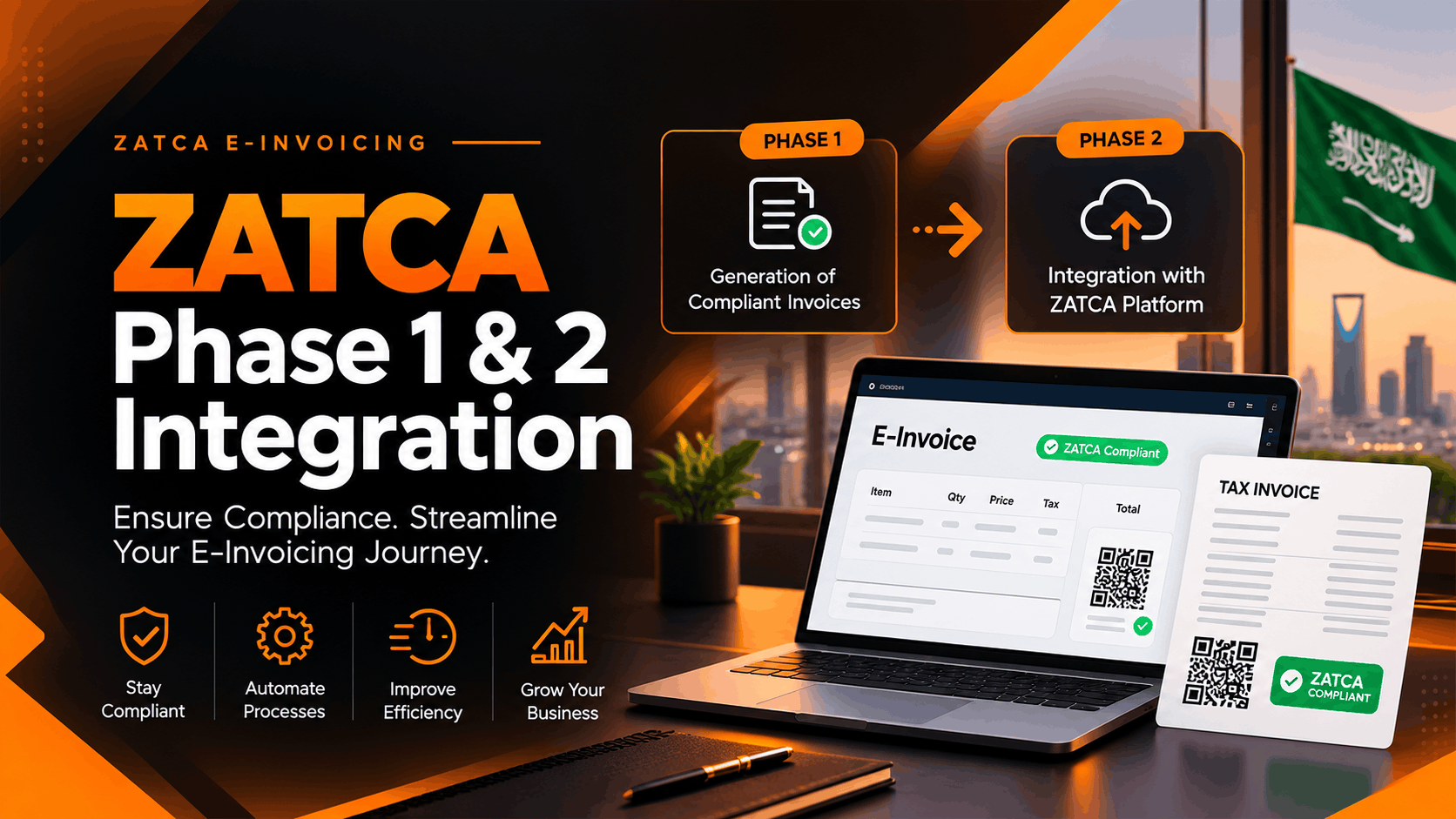
ZATCA Phase 1 & 2 Integration: A Complete Guide to E-Invoicing Compliance in Saudi Arabia
Introduction
Saudi Arabia is accelerating its digital transformation by modernizing tax administration, financial reporting, and business operations. One of the most important developments in this transformation is the implementation of electronic invoicing, commonly known as E-Invoicing or Fatoora, under the supervision of the Zakat, Tax and Customs Authority (ZATCA).
For businesses operating in the Kingdom of Saudi Arabia (KSA), understanding ZATCA Phase 1 and Phase 2 integration is essential for managing tax invoices, maintaining accurate financial records, and preparing for applicable regulatory requirements.
ZATCA introduced electronic invoicing in two main stages: Phase 1, known as the Generation Phase, and Phase 2, known as the Integration Phase. While Phase 1 focuses on generating and storing compliant electronic invoices, Phase 2 introduces additional technical requirements and integration between taxpayers' electronic invoicing systems and ZATCA's Fatoora platform.
Businesses that rely on outdated accounting processes, disconnected invoicing tools, or manual financial workflows may find these requirements challenging. A properly configured enterprise resource planning (ERP) system can simplify invoice generation, automate accounting workflows, and support integration with the required government platform.
At Innovazy, we help businesses modernize their operations through Odoo ERP implementation, Saudi-market localization, e-invoicing integration, and accounting configuration. This guide explains the differences between ZATCA Phase 1 and Phase 2, their technical requirements, the role of ERP software, and the steps businesses can take to prepare for compliant electronic invoicing.
What Is ZATCA E-Invoicing?
ZATCA is the Zakat, Tax and Customs Authority of Saudi Arabia. It administers relevant tax, zakat, and customs regulations and oversees the Kingdom's electronic invoicing framework.
ZATCA's E-Invoicing initiative, known as Fatoora, establishes requirements for generating and processing electronic invoices and related documents through compatible electronic solutions.
Electronic invoicing is more than creating an invoice in PDF format or emailing a document to a customer. It involves generating invoice data through a compliant system and following the applicable technical and business requirements.
Depending on the transaction and invoice type, the requirements can include structured invoice data, mandatory invoice fields, QR codes, cryptographic features, and communication with ZATCA's systems.
The framework has two principal implementation phases:
- Phase 1 — Generation Phase: Businesses subject to the regulation must generate and store electronic invoices and notes using a compliant electronic solution.
- Phase 2 — Integration Phase: Businesses selected for an applicable integration wave must meet additional technical and business requirements and integrate their e-invoicing solution with ZATCA's systems.
The two phases form part of Saudi Arabia's broader effort to improve tax transparency, standardize invoicing, and support digital business processes.
What Is ZATCA Phase 1 Integration?
ZATCA Phase 1, officially known as the Generation Phase, became enforceable on December 4, 2021, for taxpayers covered by the applicable regulations, subject to the stated exceptions.
The primary objective of Phase 1 is to ensure that businesses generate and store electronic invoices through a compliant electronic invoicing solution instead of relying on prohibited manual or unsuitable invoice-generation methods.
Key requirements of ZATCA Phase 1
1. Electronic invoice generation
Businesses must use a compliant electronic solution to generate applicable tax invoices and related notes. The solution should capture the required transaction information accurately and produce invoices in accordance with the applicable rules.
2. Required invoice information
Invoices must contain the information required for their particular type of transaction. Depending on the document, this can include supplier details, customer details where applicable, invoice date, transaction values, VAT information, and other prescribed fields.
3. QR code requirements
Applicable simplified tax invoices must include a QR code that complies with the relevant technical requirements. The implementation should account for the invoice type and the applicable ZATCA specifications rather than assuming that every invoice follows identical rules.
4. Secure invoice storage
Businesses need an appropriate way to store electronic invoices and related documents so that records can be retrieved when needed. Data retention, access controls, and record integrity should be considered during implementation.
5. Compliant electronic invoicing software
The invoicing system must meet the applicable ZATCA requirements. Simply creating invoices in spreadsheets or word-processing software does not, by itself, establish compliance.
Why Phase 1 matters
A properly configured Phase 1 system helps businesses standardize invoice generation, maintain consistent records, improve access to transaction information, and reduce reliance on manual paperwork.
It also creates a foundation for the more advanced technical requirements introduced in Phase 2.
What Is ZATCA Phase 2 Integration?
ZATCA Phase 2, officially known as the Integration Phase, began its rollout on January 1, 2023, through successive waves targeting specified taxpayer groups.
Unlike Phase 1, Phase 2 requires additional technical and business capabilities, including integration between the taxpayer's electronic invoicing solution and ZATCA's Fatoora platform.
ZATCA notifies targeted taxpayers of their integration requirements and applicable deadlines. Under the published framework, taxpayers are notified at least six months before their integration date.
Businesses should therefore determine whether they have received a notification, identify their applicable wave, and confirm the required implementation date instead of assuming that the same deadline applies to every taxpayer.
Key requirements of ZATCA Phase 2
1. Integration with the Fatoora platform
The e-invoicing solution must communicate with ZATCA's platform according to the applicable technical specifications. This requires appropriate system configuration, credentials, certificates, and secure API communication where applicable.
2. Structured XML e-invoices
Phase 2 requires electronic invoices to follow the applicable structured invoice format, including ZATCA's XML implementation standards. The system must generate the appropriate document structure and required fields for the relevant invoice type.
3. Cryptographic stamping and security
Applicable Phase 2 processes require cryptographic security features, including the required cryptographic stamp and associated controls. The implementation must follow the applicable technical standards and security requirements.
4. UUID assignment
The applicable invoice process requires a universally unique identifier (UUID). The invoicing system must generate, store, and associate identifiers correctly with the relevant documents.
5. Invoice clearance or reporting
The integration workflow differs according to the type of invoice.
- Standard tax invoices: Generally follow a clearance process in which the invoice is submitted to ZATCA and receives the required clearance before being issued to the buyer.
- Simplified tax invoices: Generally follow a reporting process in which the invoice is issued and then reported to ZATCA within the applicable timeframe.
The exact workflow must be implemented according to the current specifications for the relevant document and transaction.
6. Additional invoice fields and validation
Phase 2 introduces additional technical and business requirements compared with Phase 1. Businesses must ensure that invoice data, document structure, validation rules, and required fields match the applicable specifications.
7. Testing and production readiness
Integration requires more than enabling an option in accounting software. Businesses should validate their configuration, credentials, document generation, API communication, error handling, and production workflows before relying on the system for live transactions.
Why Phase 2 integration is important
Phase 2 connects the invoicing process more closely with the required regulatory platform. When implemented correctly, it can reduce repetitive administrative work, improve invoice traceability, and help finance teams manage electronic invoicing through more consistent workflows.
It also requires more careful technical planning than Phase 1, particularly for businesses that issue large invoice volumes or operate multiple branches, legal entities, sales channels, or accounting systems.